

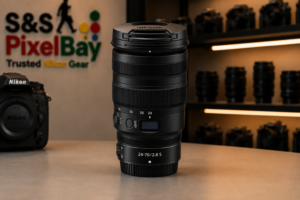

Choosing the right Nikon lens can make just as much difference to your photography as choosing the camera itself. Focal length, maximum aperture, lens mount, size and intended use all affect which lens will suit you best.
Whether you are looking for an everyday zoom, a portrait lens, a wide-angle option or a powerful telephoto lens for wildlife, understanding the basics will help you make a more informed choice.
Nikon F-Mount or Z-Mount?
The first thing to check is which lens mount your camera uses.
Nikon F-mount lenses were designed primarily for Nikon DSLR cameras and are available in a huge variety of focal lengths and specifications. The extensive used market can make F-mount lenses particularly attractive for photographers looking for good value.
Nikon Z-mount lenses are designed for Nikon’s Z-series mirrorless cameras. The larger Z mount allows Nikon to produce modern optical designs across a wide range of lenses.
Some Nikon F-mount lenses can also be used on compatible Nikon Z cameras with an appropriate Nikon mount adapter. However, compatibility and available functions can vary depending on the particular camera, lens and adapter.
Always check compatibility before purchasing.
Prime or Zoom Lens?
A prime lens has a fixed focal length, such as 35mm, 50mm or 85mm.
Prime lenses can offer excellent image quality and wide maximum apertures while often remaining relatively compact. They are popular for portraits, street photography and low-light shooting.
A zoom lens covers a range of focal lengths, such as 24–70mm, 70–200mm or 180–600mm.
Zoom lenses provide greater flexibility because you can change your framing without changing lenses. They are particularly useful for travel, events, wildlife and situations where subjects may be at different distances.
Neither type is automatically better. The right choice depends on how you photograph.
Understanding Focal Length
Focal length affects both your field of view and how large your subject appears in the frame.
Wide-angle lenses are commonly used for landscapes, architecture, interiors and travel.
Standard focal lengths are useful for everyday photography, street photography and general-purpose shooting.
Short telephoto lenses are particularly popular for portraits because they can provide comfortable working distances and attractive subject separation.
Long telephoto and super-telephoto lenses are commonly chosen for wildlife, birds, aviation, motorsport and other distant subjects.
Remember that the effective field of view also depends on whether your camera uses a DX or FX sensor.
Why Maximum Aperture Matters
A lens with a wider maximum aperture can allow more light to reach the camera sensor.
This can be useful when photographing in lower light and can also help create a shallower depth of field, where the subject is sharp while the background appears more blurred.
However, lenses with very wide maximum apertures can be larger, heavier and more expensive.
For many photographers, a smaller and lighter lens may be more practical than choosing the widest aperture available.
What Is Nikon VR?
Many Nikon lenses feature Vibration Reduction (VR).
VR is designed to help reduce the effects of camera shake when shooting handheld. It can be particularly useful when using longer focal lengths or slower shutter speeds.
Not every photographer or situation requires VR, and stabilisation capabilities vary between lenses and camera systems. Always check the specifications of the particular lens you are considering.
Choosing a Lens for Your Photography
For portraits, photographers often choose standard or short telephoto focal lengths with relatively wide apertures.
For landscape photography, wide-angle lenses are popular, although standard and telephoto lenses can also produce excellent landscape images.
For wildlife and bird photography, longer telephoto lenses provide the reach required for distant subjects.
For travel photography, a versatile zoom can reduce the number of lenses you need to carry.
For street photography, compact prime lenses and smaller standard zooms can provide a convenient balance between image quality and portability.
For sports and action, autofocus performance, focal length and maximum aperture can all be important considerations.
What to Check When Buying a Used Nikon Lens
When purchasing a pre-owned lens, condition is particularly important.
Check the exterior for signs of impact or excessive wear and examine the available photographs carefully.
The focus and zoom rings should be considered, along with switches, buttons and other controls where applicable.
Optical condition is also important. Look for information regarding scratches, haze, fungus or other optical issues.
A small amount of internal dust can occur in used lenses and does not necessarily affect photographs, but the condition should be accurately described by the seller.
Check the lens mount and electronic contacts, and confirm exactly which accessories are included, such as front and rear caps, lens hood, case or tripod collar.
Check Compatibility Before Buying
Never assume that a Nikon-branded lens will automatically provide full compatibility with every Nikon camera.
Nikon has produced many different cameras and lenses over several generations. Features such as autofocus, metering, stabilisation and electronic communication can depend on the specific combination being used.
Check the exact model of both your camera and the lens before purchasing.
Find the Right Lens for Your Photography
The best Nikon lens is not necessarily the most expensive one. It is the lens that gives you the focal length, features and handling that suit the photographs you want to create.
At S&S PixelBay, we focus on quality used cameras, lenses and accessories. Our equipment is carefully checked before sale and accurately described to help you make a more informed buying decision.
Explore our available Nikon lenses and find the right addition to your camera bag.